
Your Location:Home>Browse special issues>Special topic on DNA molecular identification of animal medicinal materials
Special topic on DNA molecular identification of animal medicinal materials
The inhibitory effects of asarum volatile oil on CYP1A2, CYP2D6, CYP2E1, CYP3A4 and CYP2C19 human liver microsomal enzymes were screened by Cocktail probe substrate method. The binding ability of volatile oil components and intermediates to CYP1A2 enzyme was studied by semi-flexible molecular docking method.
Theme Keywords: Molecular identification
- The Paper
- Abstract:Objective:Syngnathus has long been used as an important traditional animal medicine in China, but many syngnathus-like animals also used as Hailong in herbal markets. This study aims to define the zoological origin of Syngnathus in China Pharmacopoeia.Method:Herbalogical records, particularly pictures and photographs of ancient literatures, Syngnathus specimens in museum were stidued to determine the zoological origin of Syngnathus in Chinese herbal medical classics and China Pharmacopoeia.Result:Based on the morphological and DNA sequencing, all the commercial "S. acus" originated from Syngnathus schlegeli (Kaup, 1856). Feature description of "S. acus" in China Pharmacopoeia also conformed to S. schlegeli. S. acus in China may be a misidentification of S. schlegeli.Conclusion:Syngnathus in China Pharmacopoeia originates from Solegnathus hardwickii (Gray, 1830), Syngnathoides biaculeatus (Bloch, 1785) or Syngnathus schlegeli (Kaup, 1856). It is suggested to add identification methods of "Hailong" , especially molecular identification methods in China Pharmacopoeia, in order to improve quality control standards of Syngnathus.Keywords:Syngnathus;zoological origin;
China Pharmacopoeia ;Syngnathus acus Linnaeus;Syngnathus schlegeli Kaup106|115|0 <HTML><L-PDF>Updated:2021-02-09
 - Abstract:Objective:Scolopendra was a traditional Chinese medicine(TCM) with a good medicinal value. Nowadays, there have been increasingly more adulterates of Scolopendra in the medicine market. To ensure the safe and effectiveness of clinical medicines, a convenient and accurate specific polymerase chain reaction(PCR) method for identification of medicinal Scolopendra from its common adulterates was established.Method:Based on the differences of COI gene DNA sequences among Scolopendra subspinipes mutilans and adulterants, the specific primer was designed, the reaction conditions were optimized, and the PCR method for identification was explored and verified in terms of tolerance and feasibility. Besides, the original animal samples and medicine of Scolopendra were collected.Result:Through the established PCR reaction system, the bright and simple fragments of 500 bp was amplified from DNA templates of S. subspinipes mutilans. All of the adulterants were negative by the multiplex PCR assay, such as S. multidens, S. subspinipes, S. dehaani, S. hainanum.Conclusion:The identified primer is highly specific, and the specific PCR method established in this paper can accurately identify Scolopendra and its adulterants, so as to provide an excellent scientific basis for the identification of TCM Scolopendra. The method is simple and intuitive, and facilitates wide promotion and application of the method, with a broad application prospect in the identification of TCM.Keywords:Scolopendra;polymerase chain reaction(PCR);
Scolopendra subspinipes mutilans ;adulterants93|91|5<HTML><L-PDF>Updated:2021-02-09 - Abstract:Objective:To obtain a rapid, efficiency and convenient polymerase Chain reaction(PCR) identification method for medicinal Cervi Cornu Pantotrichum, Cervi Cornu and its common adulterates.Method:Based on three single nucleotide polymorphisms (SNP) of Cytb gene DNA sequences among Cervus nippon, C. elaphus and its adulterants, a pair of species-specific primers (LR-238.F and LR-238.R) was designed, the reaction conditions were optimized, and the PCR method for identification was explored and verified in terms of tolerance and feasibility.Result:Through the established allele-specific PCR method, under the annealing temperature of 56 ℃ and cycle number of 35, 250 bp of fragments were amplified from DNA templates of Cervi Cornu Pantotrichum, Cervi Cornu and its subspecies in origin animal samples as well as herbal medicines. All of the adulterants species of Przewalskium albirostris, Cervus eldi, Odocoileus hemionus, Dama dama, Alces alces, Elaphurus davidianus, Capreolus pygargus, Rusa unicolor and Rangifer tarandus were negative by the PCR assay.Conclusion:The identification primer is highly specific, and the allele-specific PCR identification method established in this paper can accurately identify the medicinal Cervi Cornu Pantotrichum and Cervi Cornu.Keywords:Cervi Cornu Pantotrichum;Cervi Cornu;allele-specific PCR;adulterants;
Cervus nippon ;C. elaphus 121|114|10<HTML><L-PDF>Updated:2021-02-09 - Abstract:Objective:In recent years, with the increase in the commodity price of medicinal pheretima, there have emerged increasing adulterates in the medicine market. Besides, the medicinal materials have mostly lost the main identification features, and are difficult to distinguish. Therefore, it is urgent to establish an accurate and stable method for the identification of pheretima.Method:According to the differences of COI gene DNA sequences among Pheretima aspergillum, Pheretima vulgaris, Pheretima guillelmi, Pheretima pectinifera and adulterants, the variation site was found, the specific primers were designed, the reaction conditions were optimized, and the polymerase Chain reaction(PCR) method for identification was explored and verified in terms of tolerance and feasibility in this study. The specific primers were combined to build multiple PCR systems. An effective, accurate, convenient, highly specific and repeatable Multiplex Allele-Specific PCR identification method was established for identifying medicinal pheretima and its common adulterants.Result:Through the established multiplex PCR reaction system, 366, 487, 487 and 475 bp of fragments were amplified from DNA templates of P. aspergillum, P. vulgaris, P. guillelmi and P. pectinifera respectively. All of the adulterants were negative by the multiplex PCR assay. The PCR amplification of specific alleles method established in this paper can accurately identify pheretima.Conclusion:The Multiplex Allele-Specific PCR identification method established in this paper can accurately identify medicinal pheretima and its adulterants.Keywords:Pheretima;multiplex allele-specific polymerase chain reaction;molecular identification;adulterants;
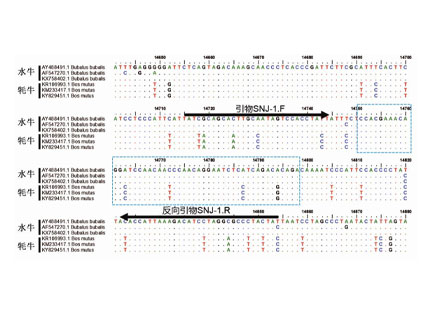
Pheretima aspergillum ;Pheretima vulgaris ;Pheretima guillelmi ;Pheretima pectinifera 138|130|9<HTML><L-PDF>Updated:2021-02-09 - Abstract:Objective:To establish a rapid on-site method for identifying Chinese medical material recombinase-mediated amplification (RAA) technology for the use of identifying medicinal Bubali Cornu from yak horn.Method:Based on the differences of mitochondrial genome sequences between Bubali Cornu and adulterants, the specific RAA primer (SNJ-1.F, SNJ-1.R) and fluorescence probe SNJ-1.probe were designed by variation sites. Alkaline lysis method was used to extract DNA from milled samples, and optimize RAA reaction system. The incubation was made at 37 ℃ for 15-20 min, the reaction results were monitored through gel electrophoresis and a mobile fluorescence amplification instrument. The RAA identification result was compared with COI DNA sequencing.Result:After incubation at 37 ℃ for 20 min, about 140 bp of bright and simple bands was amplified from DNA templates of Bubalus bubalis, whereas Bos mutus were negative. By the Real-time fluorescent RAA identify method, all reactions in DNAs from Bubali Cornu samples were amplified from 6.21 to 8.37 min, whereas DNAs from yak samples were amplified after 10.08 min, COI sequencing results conformed to the Real-time fluorescent RAA identification.Conclusion:Specific RAA could rapidly identify Bubali Cornu in 20 minutes, and thus be applied in medical material and its products. This method is simple, rapid and sophisticated instrument-free, with promises in on-site identification of traditional Chinese medicine.Keywords:Bubali Cornu;yak horn;recombinase-mediated amplification;adulterants;on-site identification114|130|3<HTML><L-PDF>Updated:2021-02-09
- Abstract:Objective:A polymerase Chain reaction(PCR) identification method for Suis Fellis Pulvis and its Chinese patent medicines was established to provide an example for the identification of animal-derived components in complex components.Method:A PCR identification method was established based on swine derivatives identification primers, the reaction system was optimized, and the established method was investigated and verified. By the established PCR identification method, the swine derivatives of 20 batches of self-made Suis Fellis Pulvis material, 19 batches of commercially available Suis Fellis Pulvis and 22 batches of Chinese patent medicines containing Suis Fellis Pulvis were identified. The commercially available Suis Fellis Pulvis material and Chinese patent medicines containing Suis Fellis Pulvis positive products that were amplified PCR were verified by enzyme digestion and sequencing.Result:Totally 20 batches of self-made Suis Fellis Pulvis material and Suis Fellis Pulvis control material could expand the specific identification band of about 212 bp, and there was no bands in bovine and ovine reference, only 5 batches of the 19 batches of commercially available Suis Fellis Pulvis had expanded specific identification bands, 10 batches of 22 batches of Chinese patent medicines containing Suis Fellis Pulvis were detected to have swine derivatives, the Suis Fellis Pulvis control material and the PCR-amplified commercially available Suis Fellis Pulvis material positive products can produce about 200 bp of bands after digestion with Mnl I. The highest similarity between the amplification products sequence of Suis Fellis Pulvis and its Chinese patent medicines, and the GenBank database was Sus scrofa, the consistency was 99%, which conformed to the sequence of swine.Conclusion:The PCR identification method established in this paper can accurately identify the biological origin of Suis Fellis Pulvis and its Chinese patent medicines.Keywords:Suis Fellis Pulvis;Chinese patent medicine;specific polymerase Chain reaction(PCR);molecular identification86|109|9<HTML><L-PDF>Updated:2021-02-09
- Abstract:Objective:To screen the specific reverse primers of Galli Gigerii Endothelium Corneum, duck gizzard membrane and goose gizzard membrane, and establish a specific PCR for molecular identifying Galli Gigerii Endothelium Corneum and its common adulterants.Method:Based on the mutation sites on the 12S rRNA sequence, specific polymerase Chain reaction(PCR) identify primers were designed for chicken, duck and goose gizzard membrane. The specific PCR reaction conditions were optimized, and the PCR identification method was explored and verified in terms of tolerance and feasibility. Thirty batches of Galli Gigerii Endothelium Corneum decoction pieces extracted from the test were identified.Result:Thirty batches of Galli Gigerii Endothelium Corneum decoction pieces were detected using chicken-specific primers, 273 bp of specific bands was amplified and visualized on the agarose electrophoregram. When duck and goose primers were used, no corresponding amplified band was detected.Conclusion:The allele-specific PCR method can be used as a rapid and accurate method to identify Galli Gigerii Endothelium Corneum. It is a promise method for special sampling tasks of Chinese herbal medicine and decoction tablets nationwide.Keywords:Galli Gigerii Endothelium Corneum;duck Gizzard Membrane;goose Gizzard Membrane;adulterants123|175|9<HTML><L-PDF>Updated:2021-02-09
- Abstract:Molecular Pharmacognosy is a new interdisciplinary subject formed by the organic integration of molecular biology and pharmacognosy. It is highly practical and innovative. In the course of teaching, both experimental teaching and theoretical teaching are of great significance. " Molecular Identification of Traditional Chinese Medicine" and the traditional teaching mode of confirmatory experiment are the preferred choices for the establishment of Molecular Pharmacognosy experimental courses in universities and colleges. Molecular Pharmacy is a forward-looking discipline with many emerging methods and technologies. Basic experimental teaching is not enough for students to learn this subject better, so it is especially important to introduce the latest scientific research results in experimental teaching. Experimental teaching based on the transformation of the latest scientific research results not only enables students to master basic experimental skills, but also broadens the breadth of students' knowledge, cultivates students' scientific research ideas, stimulates students' innovation spirit. Some suggestions and prospects have been put forward for the compilation of experimental teaching materials, the construction of experimental platform, the cultivation of teachers and academic exchanges. It is hoped that the contents of experimental textbooks will be developed from confirmatory experiments to comprehensive experiments, and the experimental platform for rational, standardized and efficient use will be built. Meanwhile, experimental courses involving multiple fields can be completed by multi-disciplinary teachers, and it is encouraged to actively carry out and participate in flexible, diverse, lively and interesting teaching practices. All the suggestions are intended to promote the development of Molecular Pharmacognosy.Keywords:molecular pharmacognosy;experimental teaching;scientific research results;experimental teaching materials;experimental platform;the cultivation of teachers;academic exchanges104|69|0<HTML><L-PDF>Updated:2021-02-09


